




History
|

Objectives of Skills Competition
The Skills Competition acts as a stage to advocate for the significance of skills, inspiring young individuals to engage in vocational training and education. By showcasing their talents in competitions, participants capture the attention and interest of the public. The competitions also provide an opportunity to assess the outcomes of our vocational training and education, leading to improvements in technical proficiency. As our nation continues to advance in technology-driven and service industries, there is a pressing need for a skilled workforce. Therefore, it is crucial to promote technical and vocational education, expand the scope of skills assessments, and comprehensively bolster the reach and impact of skills competitions, aiming to attract the younger generation to participate in vocational training, empowering them to become the cornerstone of our country's economic and social development.
About the National Skills Competition
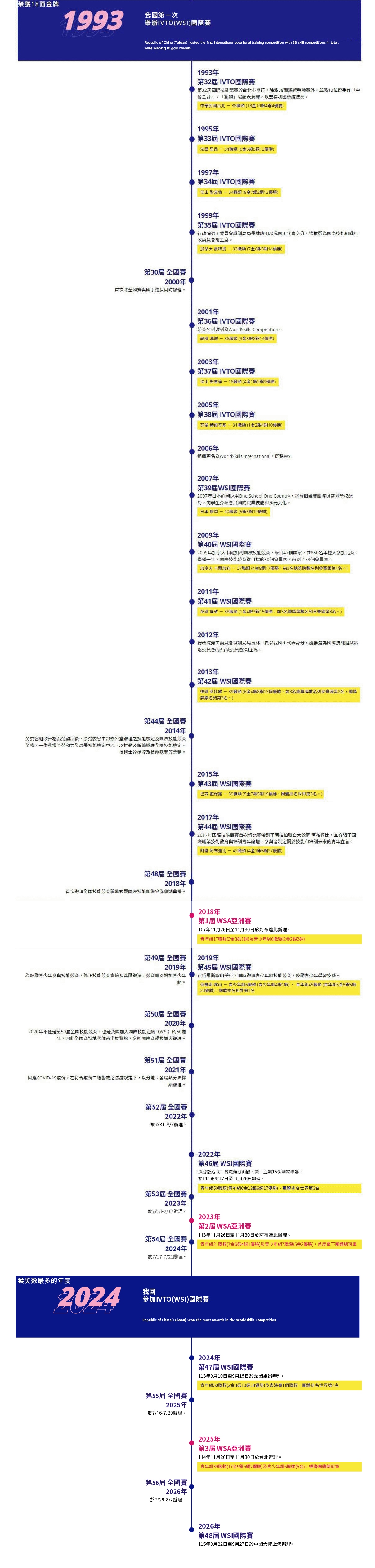
Taiwan has held the National Skills Competition annually since its inaugural edition in 1968. Each year, government agencies, schools, corporate affiliates, organizations, companies, and vocational training institutions actively nominate competitors to take part. The competition stands as the hallmark annual event in vocational training and technical and vocational education.
In addition, the National Skills Competition plays a crucial role in selecting outstanding competitors to represent Taiwan in the WorldSkills Competition and the WorldSkills Asia Competition. To align with international standards, the age limit for competitors in the official skills is under 21 (with the exception of 10 skills: ICT Network Infrastructure, Manufacturing Team Challenge, Mechatronics, Aircraft Maintenance, Industry 4.0, Cloud Computing, Cyber Security, Industrial Design Technology, Digital Construction (BIM), and Robot Systems Integration, where the age limit is under 24).
The junior skills primarily target students currently enrolled in junior high schools (subject to the competition guidelines of each year in accordance with WorldSkills International requirements), ensuring full compliance with the regulations set by WorldSkills International and WorldSkills Asia.
To meet the demand for skilled talents driven by rapid economic development, the number of competition skills has grown from the initial 14 to 56 official skills and 13 junior skills, as detailed below:
1. Official Skills (56 skills in total): Industrial Mechanics, ICT Network Infrastructure, Manufacturing Team Challenge, Mechatronics, Mechanical Engineering CAD, CNC Turning, CNC Milling, Mobile Applications Development, Software Applications Development, Welding, Wall and Floor Tiling, Autobody Repair, Aircraft Maintenance, Plumbing and Heating, Electronics, Web Technologies, Electrical Installations, Industrial Control, Bricklaying, Plastering and Drywall Systems, Painting and Decorating, Autonomous Mobile Robotics, Cabinetmaking, Joinery, Jewellery, Floristry, Hairdressing, Beauty Therapy, Fashion Technology, Pâtisserie and Confectionery, Automobile Technology, Cooking, Restaurant Service, Car Painting, Landscape Gardening, Refrigeration and Air Conditioning, IT Network Systems Administration, Graphic Design Technology, Health and Social Care, Construction Metal Work, Plastic Die Engineering, Visual Merchandising, Prototype Modelling, Bakery, Industry 4.0, 3D Digital Game Art, Cloud Computing, Cyber Security, Hotel Reception, Digital Construction (BIM), Industrial Design Technology, Robot Systems Integration, Traditional Chinese Cooking, Traditional Chinese Costume, Sheet Metal Technology, and Foundry & Casting.
2. Junior Skills (13 skills in total): Mechanical Engineering CAD, Software Applications Development for Junior, Electronics for Junior, Web Technologies for Junior, Electrical Installations for Junior, Industrial Control for Junior, Painting and Decorating for Junior, Autonomous Mobile Robotics for Junior, Floristry for Junior, Hairdressing for Junior, Restaurant Service for Junior, Graphic Design Technology for Junior, and 3D Digital Game Art for Junior.
Non-WSI Official Skills (8 skills in total): Traditional Chinese Cooking, Traditional Chinese Costume, Sheet Metal Technology, Foundry & Casting, Manufacturing Team Challenge, Construction Metal Work, Plastic Die Engineering, and Prototype Modelling.
Competitors who rank in the top 5 of the official skills at the National Skills Competition will be awarded prize money, medals, and certificates. Furthermore, in accordance with the Articles Regarding Screening and Review and Recommendation Admission Regulations for Technically and Artistically Talented Students at Secondary Schools and Above , these winners are eligible for Admission via Screening and Review or Admission via Recommendation to vocational high schools, five-year or two-year junior colleges, four-year colleges of technology, or university departments in related fields. This pathway is designed to cultivate backbone skilled talent who possess both theoretical knowledge and practical expertise.
Under the Regulations on Technician Skills Certification and Issuance of Certificates , competitors joining the official skills and achieving a passing score in the National Skills Competition may benefit from preferential treatment. Within three years of the passing date, they may apply for an exemption from the practical test when taking Class B, Class C, or Single Level technician certification in related skills.
About the WorldSkills Competition
WorldSkills International, formerly known as the International Vocation Training Organization, was first held in Spain in 1950. Forward to today, it has expanded its reach to over 80 member countries and regions, with its secretariat based in the Netherlands. Committed to fostering global cooperation among young technicians, WorldSkills International organizes the WorldSkills Competition, along with conferences and seminars, to facilitate mutual observation, understanding, and exchange of expertise in vocational training and education.
WorldSkills Competition is held biennially and member countries and regions can apply to host the event. To date, 46 Competitions have been held, with currently over 50 official Skills.
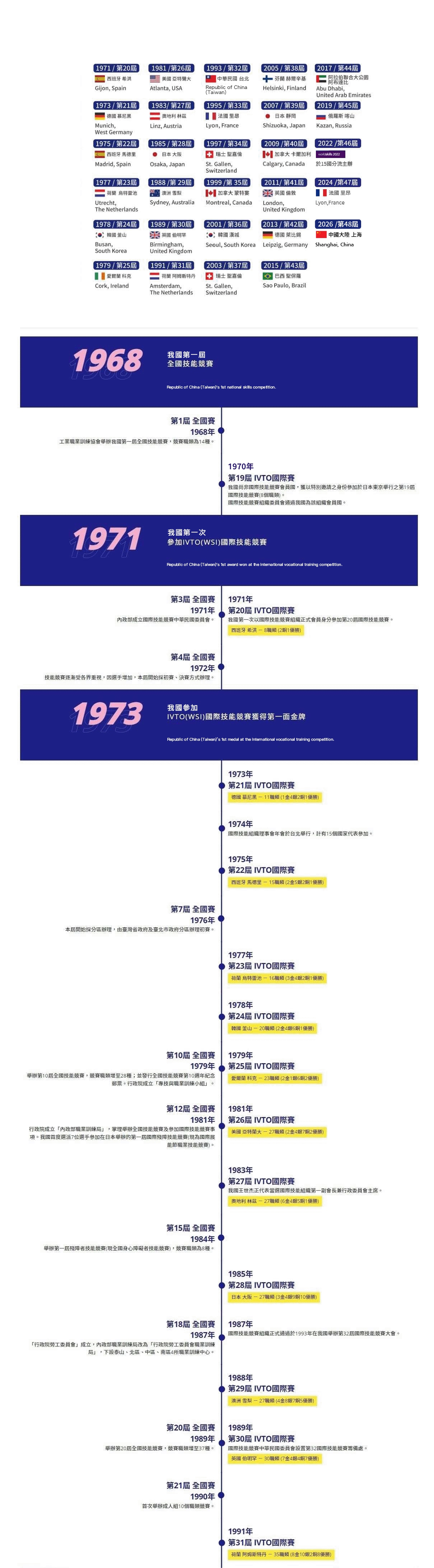
Taiwan became a member of WorldSkills International in 1970, taking part in the 20th WorldSkills Competition. Since then, Taiwan has participated in every WorldSkills Competition, showcasing remarkable performances that have earned global recognition. Notably, Taiwan had the honor of hosting the 32nd WorldSkills Competition in Taipei in 1993, which was a resounding success!
The 40th WorldSkills Competition unfolded in Calgary, Canada, from September 1st to 7th, 2009. Taiwan fielded a team of 42 Competitors across 37 skills, achieving success with 4 gold medals, 8 bronze medals, and 17 Medallions for Excellence. This performance secured our country the 4th position among participating nations based on total medal points.
In the 41st WorldSkills Competition held in London, UK, from October 5th to 8th, 2011, Taiwan selected 43 Competitors competing in 38 Skills, winning 1 gold medal, 4 silver medals, 3 bronze medals, and 15 Medallions for Excellence. Taiwan was ranked 8th among the participating countries based on total medal points.
The 42nd WorldSkills Competition, hosted in Leipzig, Germany, from July 2nd to 7th, 2013, witnessed Taiwan's ascent in the rankings. With 44 Competitors competing across 39 Skills, Taiwan clinched an impressive array of 6 gold medals, 4 silver medals, 8 bronze medals, and 13 Medallions for Excellence. This performance propelled our country to the 2nd position based on total medal points and 3rd based on total points among participating countries.
In the following edition, the 43rd WorldSkills Competition held in São Paulo, Brazil, from August 11th to 16th, 2015, Taiwan's prowess continued to shine. With 41 Competitors competing in 39 Skills, Taiwan secured 5 gold medals, 7 silver medals, 5 bronze medals, and 19 Medallions of Excellence, earning the 3rd position globally.
Moving forward to the 44th WorldSkills Competition in Abu Dhabi, United Arab Emirates, from October 14th to 19th, 2017, Taiwan sent 47 Competitors across 42 Skills. The result was 4 gold medals, 1 silver medal, 5 bronze medals, and 27 Medallions for Excellence, securing Taiwan's 4th position in the world based on total medal and medallion points.
The 45th WorldSkills Competition was held in Kazan, Russia, from August 22nd to 27th, 2019, With 50 youth Competitors competing in 45 Skills and 8 junior Competitors across 6 Skills, Taiwan's youth team clinched 5 gold medals, 5 silver medals, 5 bronze medals, and 23 Medallions for Excellence, maintaining Taiwan's 4th position globally. Additionally, the junior team contributed with 4 silver medals and 1 bronze medal.
The 46th WorldSkills International (WSI) announced on June 30th, 2022 the hosting of the WorldSkills Competition 2022 Special Edition (WSC2022SE), featuring a decentralized format. Competitions across various Skills were held by 15 countries in Europe, America, and Asia from September 7th to November 26th, 2022. The 15 host countries included Austria, Canada, Denmark, Estonia, Finland, France, Germany, Italy (South Tyrol), Japan, South Korea, Luxembourg, Sweden, Switzerland, the United Kingdom, and the United States. Taiwan clinched a total of 6 gold medals, 13 silver medals, 6 bronze medals, and 17 Medallions of Excellence, ranked 3rd among 57 participating countries.
The 47th WorldSkills Competition took place in Lyon, France from Sep. 10th to Sep. 15th, 2024. Taiwan sent 58 competitors to compete in 50 skill categories and brought home 2 gold medals, 3 silver medals, 10 bronze medals and 28 awards for excellence.
The 48th WorldSkills Competition, hosted by China, will take place in Shanghai from September 22 to September 27, 2026.